I wake up in a quiet room, there are tibetan prayer flags on the wall on the right, the curtain is gently moved by the wind. It is around 6 am and I can feel that the sunrise is around the corner, the darkness is softly becoming less dense. Where again am I?
Apologies, reader, I have teleported us straight from 2015 into 2024. Nonlinear progression of my posts was triggered by the wish to share the story that has been maturing in my heart over the last months.
In May of this year I found myself packing the most needed things in a suitcase and taking a train from Geneva to the south of France, directly into the unknown. The departure that had been pre-planned 3 weeks in advance, still turned out to be quite abrupt and emotional. What was left of my old house was rubble and dust, I was not sure if I was coming back to Switzerland, what I would be doing in a month, who I would meet, however, nevermind the tears, a vaguely distinguishable sense of freedom and adventure accompanied my quickly moving body and soul on a TGV direction Montpellier.
And that’s how I arrived in a Tibetan buddhist monastery. A place where I would stay either for a month, or two (I ended up staying for three), volunteer and gather the fragments of myself back into a legible picture. I won’t be going in details about the name of the monastery or won’t be giving full names of the people to preserve the confidentiality of sorts. But let’s begin with some background:
An invisible red thread of buddhism
Yoga has been in my life for the last 17 years. Buddhism has been in my life for the last 14. It all started with a high school year in the US, where I had lots of free time, my own laptop and Internet access. Somehow I stumbled upon Osho’s books, then Krishnamurti, then started meditating on objects (fire, etc), then started reading about the history of buddhism and different branches of it. I was immediately fascinated by the clarity and seeming simplicity of buddhist concepts, and more than that, I could so much relate. I was into more ascetic traditions such as Theravada, but also while exploring Tibetan buddhism I got hooked on Tibetan culture, rich philosophy, and even attempted learning the language (didn’t go further than several words and phrases though!). Later in life, I lived in China and traveled to the border with Tibet, totally in awe of what and who I encountered (story for another time) – and a photo from Yunnan.
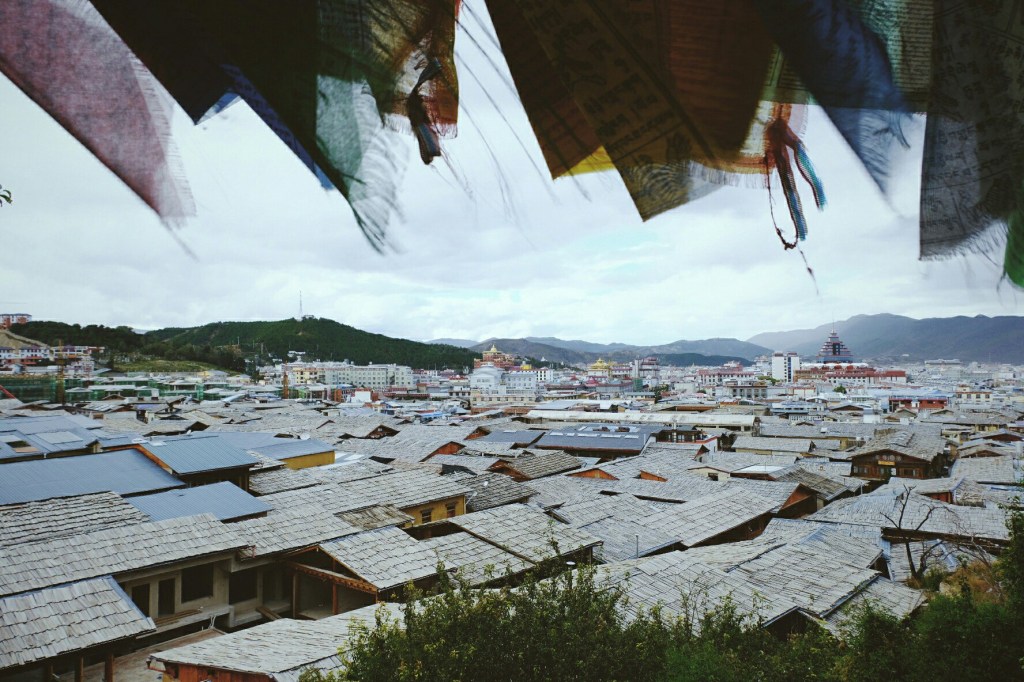
At 22 I went to a 10-day Vipassana retreat in Hongkong (Goenka, closer to theravada tradition), was absolutely blown away by the practice (silent retreats, waking up at 4, 10 hours per day of sitting meditation, no reading, no writing…) and by the benefits of it. In moderation, though, but story for another time yet again. All in all, having been fascinated by decyphering the workings of the mind for a solid half of my life, I felt that the most appropriate place for figuring things out would be in a monastery setting.
Monastery routine
Not only was/is it a monastery but also a buddhist university. There are several Buddhism study programs running, one 5 years long, another one – 7. I didn’t live in the monastery per se, as it was for men only. It is a very international place, monks and students come from all over the world (the UK, the Netherlands, Australia, France, Belgium, etc). My modest abode for the first month and a half was in a house 1 km away from the monastery that I shared with lovely women: a nun, C., a kitchen manager V., and one student. I had my own room the window of which was facing the garden with a beatiful mulberry tree that started sharing with us its berries soon after I arrived. Later in the summer I moved to the village nearby.
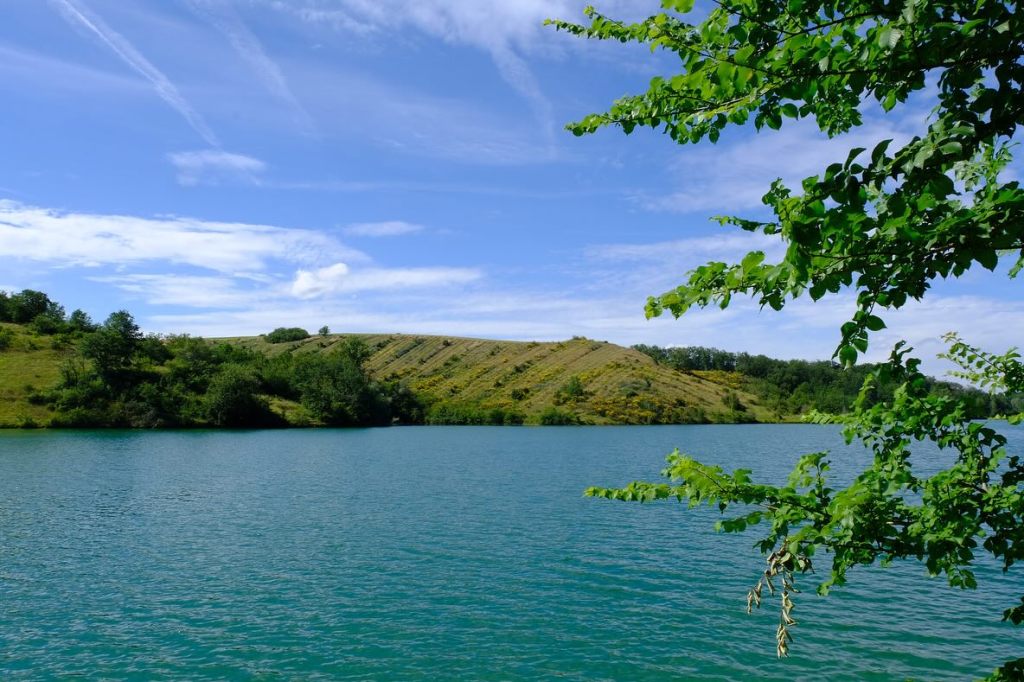
I came here to volunteer: to help in the kitchen with lunch and dinner preparation, work in the garden and in the workshop with various projects which would take 20-25 hours of my week. Several times a week, I was also giving French classes to monks and everyone interested in the library of the monastery. The schedule for the residents was simple: Breakfast (7-9), Studies (9ish to 12), Lunch (12.30-13.30) Discussions or more studies (14-16 or 17), Dinner (18-19), Rituals – Pujas (19 onwards). With due respect, I haven’t participated in evening community rituals or ceremonies. Why? I wanted my simple life. The nature, the sun, the lake, physical work, smell of flowers and trees, wind in my hair.
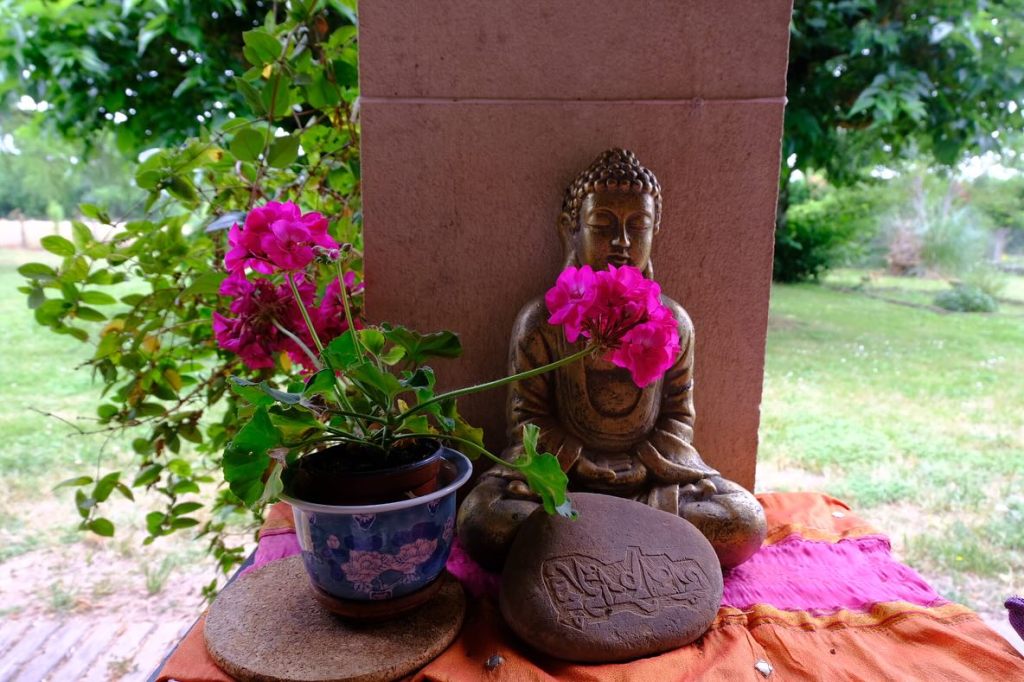
Apart from volunteering, my own rituals were: singing to a big cedar tree, riding a bike under Occitanian sun, making tea and reading a book in the garden, writing in my journal about this and that, making lego flowers from lego pieces that my lovely friend had thoughtfully ordered for me for my birthday. Occasionally, I or other volunteers would also organise day trips to explore Occitanie.
Conversations with people
I wouldn’t have thought that you could get tired of socialising in a monastery. Long kitchen shifts with other volunteers and thus long chats in French and English about the nature of the mind, quantum physics and how to make brownies, numerous people asking questions “are you a buddhist? what brings you here?”, monks telling me their life stories – all of this has been a vibrating energy field of words, feelings and ideas that I let go of every day, in the quietness of the garden or of the library.
Somehow, people like to tell me their stories. And I like to create space, listen and ask questions.
Why did you decide to become a monk or a nun?
There were stories of conflicts, external and internal, stories of heartbreak – partners who betrayed, stories of idealistic aspirations, stories of vision, stories of overwhelm, stories of profound loss, stories of being lost, stories of curiousity. There were stories that started with a preaching but after several questions turned out to be stories full of disappointment in life. The words of T. still ring in my mind at times: “There is nothing out there in the world for me, I have seen everything, and I am not interested in all that anymore”. Where there stories of love and hope? No. But there was love and hope in the eyes, in the actions, in a casually dropped word or in petting one of the cats of the monastery.
Monastery environment is like an aquarium, detached from the outer world with its noises, cars, tall buildings, movement, rush. It creates its own ecosystem over time, protective, but isolating, where you see the same people every day, where the same actions are repeated, where what is negligible in the “normal” life could become a source of intense emotions within the confines of the said ecosystem. Life narrows down to very predictable steps. One – wake up, two – have lunch, three – contribute to the community life, four – study. The aquarium becomes so predictable and safe that any unpredictable thing could become a potential challenge and source of distress, contrary to the paradigm of anicca, or impermanence, a so much favored buddhist and generally philosophical concept. This environment could make one soft and scared to go out in the world, but also could make one find a very strong core within, depending on how a person works with what arises in the mind and what has been carried within the heart before arriving to this place.
Conversations with people are such a great way to know oneself a bit more. Not that we ever get to know oneselves fully, I don’t believe in that, but with every encounter, every conversation, even a very one-sided, we can get to know something important about oneselves. How we like to be treated, our long-forgotten interests, how we can relate to others’ fears and vulnerabilities and appreciate our shared humanity.
One conversation on a universal topic with S. has particularly touched me. We were talking about questions and answers. Him, talking about trying to understand this reality, understand this world, having so many questions that have no answer, searching and not finding, with some sort of “anxiety” pushing him for the continuation of the search. Me, smiling, with all the scientists, writers, teenagers, artists floating in front of my mind’s eye, all the millions if not billions of people who tortured themselves with the same questions, wasting their suffering and adding to the long list of worries. Remembering the quote of Rainer Maria Rilke:
“Be patient toward all that is unsolved in your heart and try to love the questions themselves, like locked rooms and like books that are now written in a very foreign tongue. Do not now seek the answers, which cannot be given you because you would not be able to live them. And the point is, to live everything. Live the questions now. Perhaps you will then gradually, without noticing it, live along some distant day into the answer.”
Let’s live, my dear. Life is full of suffering, yes. But at the same time it’s also too beautiful for all these questions.
To awaken from the illusion of separateness
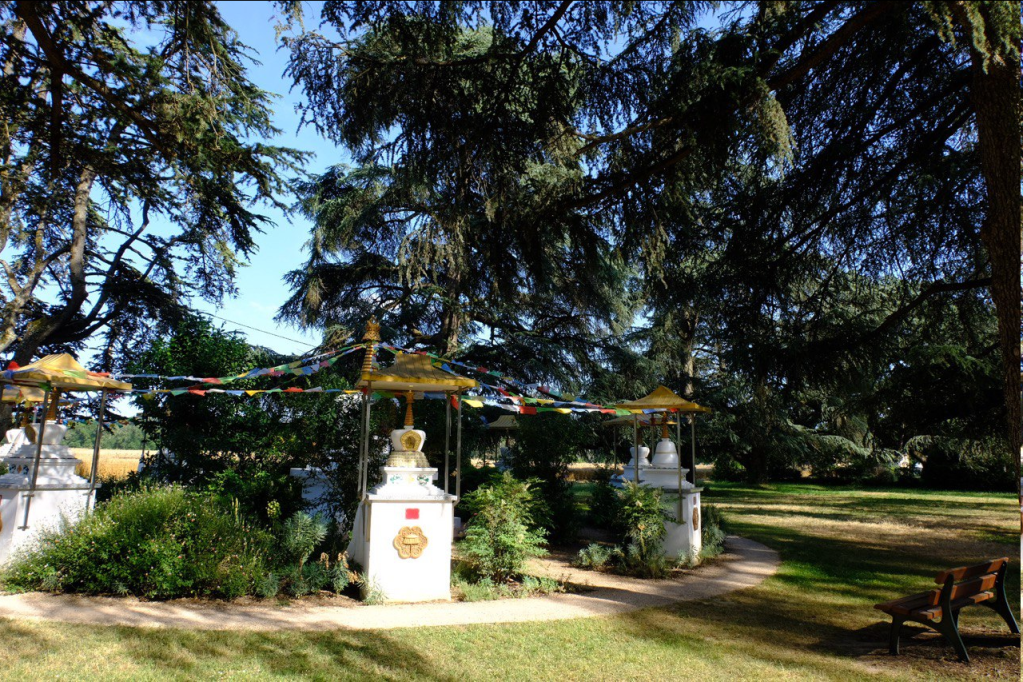
There was this phrase that I came across when trekking to Everest Base camp years ago: “We are here to awaken from the illusion of separateness”. It is one of the most profound phrases for me and it has played its role in my perception of the monastery, of the area around, of the community. The monastery as it is a place created by people for people, is like any society. With its shadow hierarchy, its power dynamics, its healers, its poets, its peacemakers, its disciplinarians. There is a place for everyone, however, everyone carries with them what and who they were before putting on the robes or becoming a student. It is fascinating to see that people will always remain people, with their fears, their cravings, their kind deeds, their resentments, their sincere desire to connect, their defensiveness, their pride, their tenderness. With some we make friends instantly, with some we just can’t connect even though we try. The behavioral dynamics tend to be even more exaggerated as the community is small and the interaction is frequent.
I could easily write several pages about every day I spent there. I could easily write even more about the insights on friendship, work ethics, solitude, creativity, meaning, vision, discipline, spontaneity, love. Might be done in the next post.
I left the monastery on the 1st of September to head back north to Switzerland. My heart is left with gratitude for what I did and learned this summer.
If you want to understand a bit more about people, pass by a monastery for some time.
If you want to accept a bit more of shadow sides and conditioning of yourself and others, pass by.
If you want to learn to distinguish love from attachment, pass by.
I will finish this writing with a quote from Yung Pueblo, that perfectly summarizes many of my thoughts during this monastery summer (and because I was listening to his book today):
“Love is interrupted by the pain we carry. It is easy to blame love itself for the
hurt we feel, but all love does is open us up. The hurt comes from the heavy
conditioning and ill-fated patterns that stop us from showing up in a
compassionate manner. A person can be in love and also unprepared to care for
that love. One can feel love for another but also have a variety of attachments that
block their appreciation for the amazing connection that is right in front of them.
Attachments, our cravings to have things exist in a very particular way, are the
rocks that clog up the mighty flow of love. Our attachments are often molded by
the hurt we have felt in the past.”
May there be less obstacles to love and less resistance to change.
 It’s all around us
Leave a comment